
Glossary
What is Profit Per Hour?
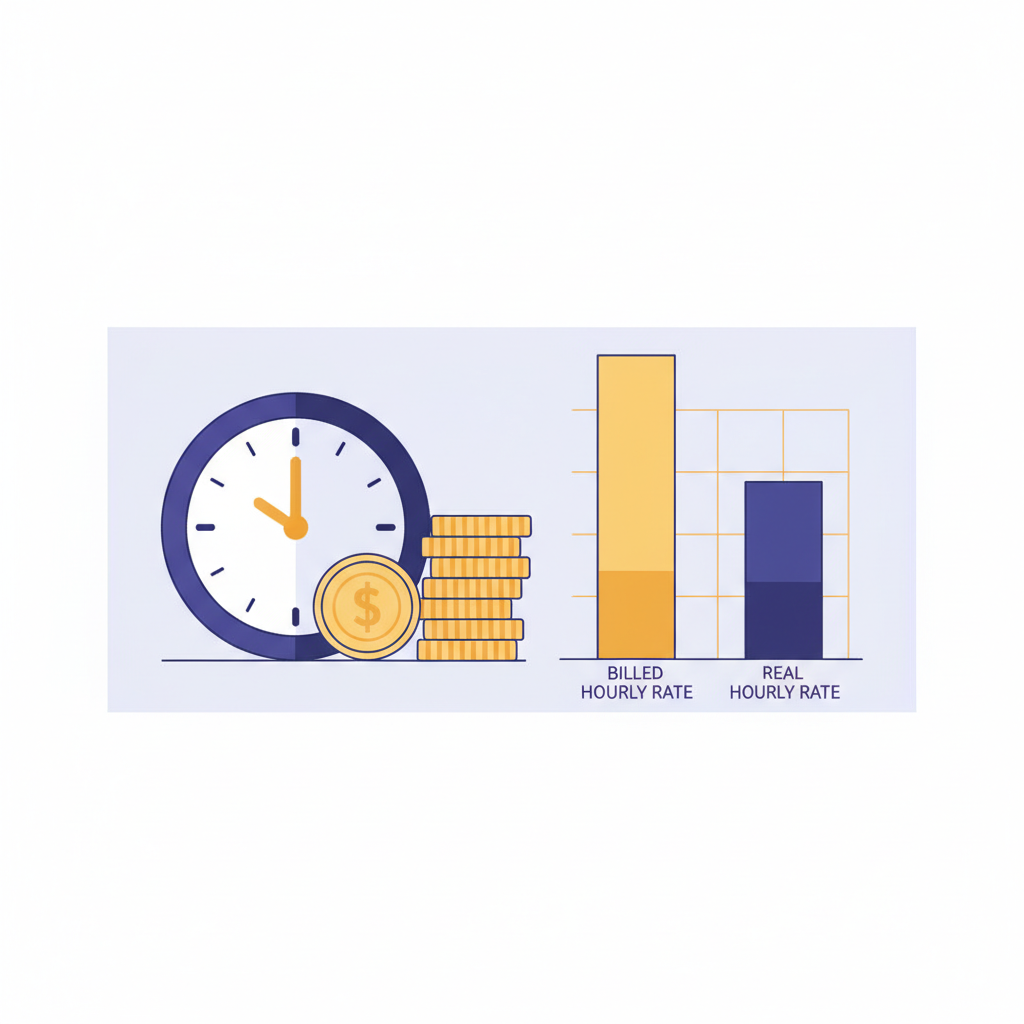
Definition
Profit per hour is the amount you actually earn for every hour you put into your business, calculated as net profit divided by total hours worked — including unbilled hours like prospecting, admin, invoicing, and rework. It's the metric that separates your quoted hourly rate from your real hourly rate.
For most freelancers, profit per hour is 30–50% lower than billed rate because billed rate only captures time spent on client deliverables, not the business-operating hours that surround them.
Why it matters
- A freelancer quoting $150/hr who spends 1 unbilled hour per 2 billed hours is really earning $100/hr. The gap compounds annually into tens of thousands of dollars of invisible rate-erosion.
- It's the metric that exposes which projects are actually worth your time. Two engagements at identical billed rates can have wildly different profit per hour based on scoping efficiency, rework, and admin overhead.
- It's the fix for imposter-rate syndrome. Freelancers who underprice themselves often do so because they compare their billed rate to a W-2 salary without realizing the unbilled-hours gap makes their actual rate far lower.
Best practices for Profit Per Hour
Track every hour, billable or not
Prospecting calls count. Invoicing emails count. Proposal drafting counts. Scope is everything worked on the business, not just what's on a client invoice.
Categorize unbilled hours into buckets
Sales & prospecting, admin, rework, tooling. Each bucket represents a different improvement lever — prospecting improves with referrals, admin improves with automation, rework improves with better scoping.
Compute weekly, track the 4-week rolling average
Single-week numbers are noisy. Rolling averages surface real trends. A sharp drop (15+ points below average) usually has a specific reason worth investigating.
Use profit-per-hour to choose between project types
Retainers and workshops with existing clients typically have the best profit-per-hour ratios (70–85% of billed rate). Cold-outreach one-off engagements are usually the worst (30–45%). Mix shift matters.
FAQ
What's a good profit-per-hour to billed-rate ratio?
New freelancers run 40–50% (heavy prospecting). Year 2–3 settles to 55–65%. Established consultants with repeat clients hit 65–75%. Productized services and retainer structures can reach 75–85%. Below 40% or above 85% usually signals a counting problem.
Do I subtract my own taxes from profit per hour?
Most freelancers use pre-tax profit per hour for operational decisions (it's comparable to a quoted rate). After-tax profit per hour matters when comparing a freelance career to a salaried alternative.
How is this different from billable utilization?
Billable utilization measures what percentage of your hours are billable — useful for consultants. Profit per hour measures what you actually earn per hour — a tighter, money-denominated version of the same signal.
Ready to know your real rate?
Hustlay tracks every tracked hour into its project's P&L and shows profit per hour live on the dashboard. See the gap between billed and real in under 60 seconds.