
Glossary
What is Self-Employment Tax?
Definition
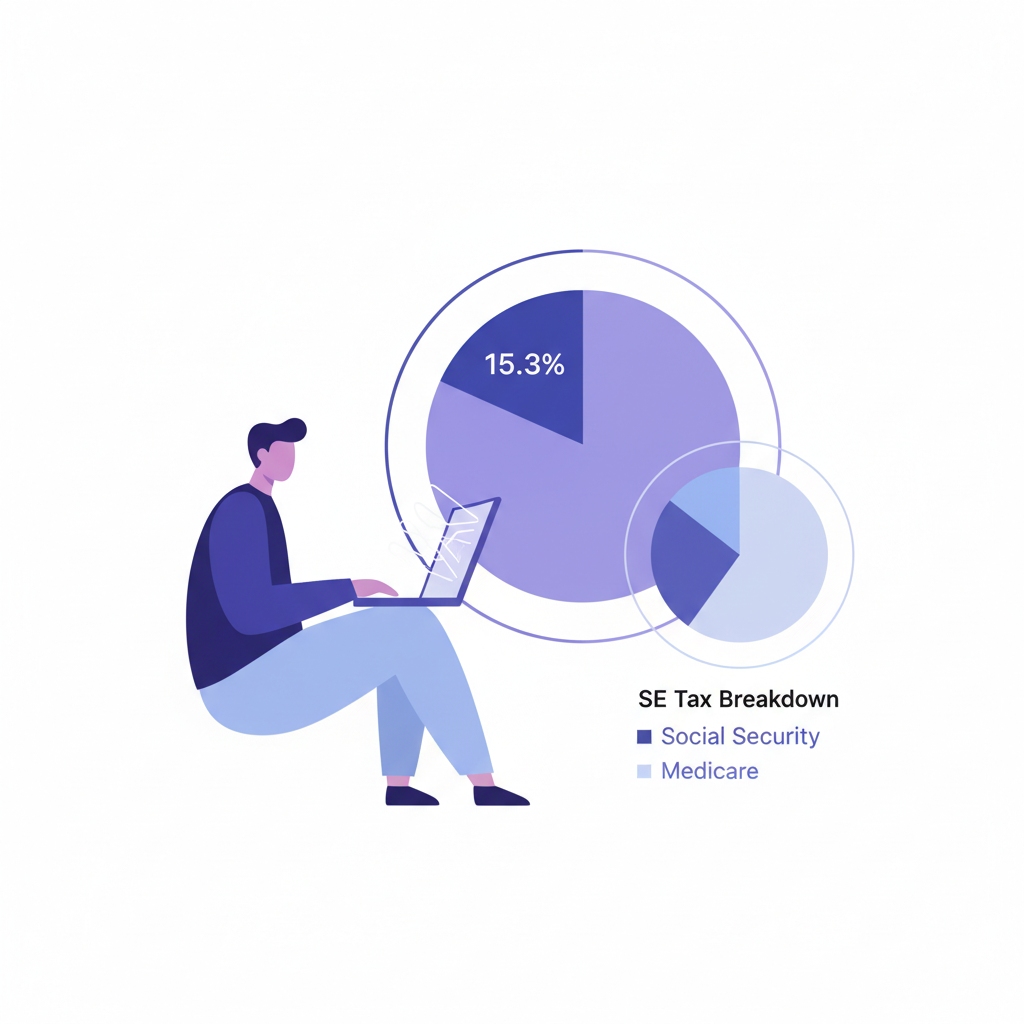
Self-employment tax is the US tax that covers Social Security and Medicare contributions for people who work for themselves. It combines both the employee and employer portions of FICA that a W-2 employee would otherwise split with a company, so the rate is 15.3% on net self-employment earnings.
The tax is split into 12.4% for Social Security (applied to the first $168,600 of net earnings in 2024) and 2.9% for Medicare (no cap), plus an additional 0.9% Medicare surtax on earnings above $200,000 single / $250,000 married.
Why it matters
- It's the single biggest tax surprise for first-year freelancers — effectively double the FICA they saw on a W-2 paystub, because they now pay both halves.
- Half of self-employment tax is deductible against federal income tax, which materially softens the effective rate but doesn't change the check you write.
- It's collected via quarterly estimated payments, not through year-end withholding, so missing deadlines triggers underpayment penalties.
Best practices for Self-Employment Tax
Set aside 30% of every payment received
A fixed-percentage sweep to a separate tax-savings account the moment money lands covers SE tax + federal income tax + most state taxes for freelancers netting $40k–$150k. Adjust upward if your state income tax is higher than average.
Pay the SE portion as part of your quarterly estimates
SE tax isn't a separate filing. It's calculated on Schedule SE with your annual 1040, but paid through quarterly Form 1040-ES payments. Missing a quarter triggers ~8% annualized interest from the missed due date.
Elect S-Corp status once net profit is consistently $40–$60k+
S-Corp election splits your earnings into reasonable W-2 salary (subject to full payroll tax) and distributions (not subject to SE tax), saving ~$2,000–$6,000/yr at the threshold. Below that, admin costs outweigh savings.
Maximize deductible business expenses
Every dollar of legitimate Schedule C deduction reduces both SE tax (15.3 cents) and income tax at your marginal rate. Home office, health insurance, and retirement contributions are the highest-leverage deductions.
FAQ
How is self-employment tax different from income tax?
They're two separate taxes on the same net profit. SE tax funds Social Security + Medicare; income tax funds general federal operations. You pay both on your freelance earnings — they stack rather than one replacing the other.
Do I pay self-employment tax if I have a full-time W-2 job?
Only on your self-employment earnings, not your W-2 wages. You get credit for Social Security already withheld from the W-2, so if your W-2 income already exceeds the $168,600 cap, the 12.4% Social Security portion of SE tax stops.
Is self-employment tax deductible?
Half of it is deductible against your federal income tax on Schedule 1, Line 15. The deduction doesn't reduce the SE tax itself, only the income tax calculated on the same dollars.
When do I pay self-employment tax?
Through quarterly estimated payments due April 15, June 15, September 15, and January 15. The balance (or refund) reconciles when you file Form 1040 in April.
Ready to stop guessing what you'll owe?
Hustlay calculates your estimated quarterly SE tax + income tax automatically from your real-time Schedule C profit, and flags underpayment risk before each deadline.